
إظهار الرسائل ذات التسميات english. إظهار كافة الرسائل
إظهار الرسائل ذات التسميات english. إظهار كافة الرسائل


Conference of the Sociological Society
כנס האגודה הסוציולוגית 7-9.2.2022
מושב:
סביבה מורכבת חלק ג׳: אקולוגיה פוליטית של ישראל/פלסטין [קהילת סביבה וחברה]
יו"ר ד"ר מתן קמינר, האוניברסיטה העברית;
ד"ר מירי לביא נאמן, מכון ערבה ללימודי
סביבה
מגיבה ד"ר אריז' סבאע'-ח'ורי, האוניברסיטה
העברית
מציגים:
נסרין מזאוי, אוניברסיטת חיפה - טרנספורמציה תרבותית באקולוגיה העירונית של נצרת
ד"ר מתן קמינר, האוניברסיטה העברית - הפרכת ״הפרחת השממה״: לקראת אקולוגיה פוליטית של הציונות
שחר שלוח, אוניברסיטת תל אביב - סימוני טריטוריה בשולי המדינה
ד"ר ראמז עיד, האוניברסיטה הפתוחה - אתנו-היסטוריה בכפר קדס: על חשיבות המחקר הסביבתי- חברתי בכפרים הפלסטיניים ההרוסים
תקציר
טרנספורמציה
תרבותית באקולוגיה העירונית של נצרת
נסרין מזאוי, המחלקה
לאנתרופולוגיה, אוניברסיטת חיפה
הוגש ב: אוקטובר 2021
מחקר אקו-אתנוגרפי זה עוסק בסביבה ובאקולוגיה העירונית של נצרת. הוא מתמקד בחוואכיר (יחיד: חאכורה), גינות הבית המסורתיות, כמוסד אקולוגי-תרבותי המאפשר חקלאות עירונית, מעשיר את המגוון הביולוגי העירוני, ומחזק את החוסן החברתי והכלכלי. במסגרת שיטת הבעלות המשותפת על הקרקע שפעלה בתקופה העותמאנית, המשאע, החוואכיר היו חלק מהמשאע הקטן. בניגוד למשאע הגדול המחולק מחדש מדי מספר שנים, החלוקה של המשאע הקטן קבועה ואינה משתנה. מכאן שהטיפוח והעיבד של החוואכיר היה לטווח ארוך דבר שהשתקף במבנה הפיזי שלהן ובתוכלתן הביולוגית.
המעקב אחרי הביוגרפיות והמטמורפוזה של החוואכיר
בעיר נצרת, חושף שינויים אקולוגיים ותרבותיים שעברו על העיר בעשורים האחרונים ומגלה
שכבות של שינויים חברתיים, כלכליים ופוליטיים בחייה של עיר פלסטינית שנותרה יחידה במדינת
קולוניאליזם-התיישבותית שנבנתה על חורבן החברה הפלסטינית והערים שלה. שינויים אלה ניכרים
בשני תחומים מרכזיים. הראשון,
סגנון המגורים ואופן החלוקה של
המרחב העירוני. השני, טרנספורמציה תרבותית-כלכלית מעיר שנשענה במידה רבה על כלכלת קיום
לכזו התלויה לחלוטין בכלכלה קפיטליסטית.
היעלמותן ההדרגתית של החוואכיר מהנוף
העירוני של נצרת מהדהדת הבדלים נוספים יותר גדולים בין השכונות הוותיקות של העיר
לבין אלה החדשות. בעוד שהשכונות הוותיקות התאפיינו בהומוגניות קהילתית ובהטרוגניות
מעמדית, השכונות החדשות מתאפיינות בהטרוגניות קהילתית ובהומוגניות מעמדית. מחסור
בקרקע, עליית מחירי המים כתוצאה להפרטת שירותי המים בישראל לצד שינויים בסגנון
החיים של תושבי העיר, הפכו את החאכורה ממרחב ביתי יצרני, פורה ובר-קיימא למרחב
צריכה ולפריווילגיה כלכלית שרק גברים אמידים יכולים להרשות אותה לעצמם.
החאכורה התפיסות שלה והיחס אליה
משקפות תפיסות ויחס של האוכלוסייה הפלסטינית כלפי הטבע והסביבה. המתח בין האזרחים הפלסטינים
לבין רשויות המדינה והשלטון שלה והמתח בינם לבין ההגמוניה של התנועה הסביבתית
בישראל מהווים מכשול בפני המשך קיומה של החאכורה כמוסד אקולוגי-תרבותי,
מעכבים את הפוטנציאל האקולוגי והסביבתי הטמון בה, עוצרים את תהליכי הלמידה הבין-דוריים
ומונעים את ההעברה של הידע האקולוגי המצטבר לדורות העתיד. יתרה מכך, הם חוסמים את
הגילום של החאכורה כמוסד לחקלאות עירונית ומחמיצים את פוטנציאל הקיימות הרחב
הגלום בה.
Book Launch: "The Palestinian City: Issues in Urban Transformations"
Book Launch
SPEAKERS: Adel Manna, Lisa Taraki, Nisreen Mazzawi, Basil Rayan, Majdi al-Malki.
Institute for Palestine Studies in Partnership with A.M. Qattan Foundation
Date: January 24, 2022 - 6:00pm
تناقش هذه الحوارية أوراق من كتاب "المدينة الفلسطينية: قضايا في التحولات الحضرية". والدراسات في هذا الكتاب تتضمن مجموعة من القضايا ذات العلاقة بالتحولات التي شهدتها المدن الفلسطينية منذ نهاية القرن التاسع عشر حتى الآن. وتشترك جميعها في إبراز أهمية العوامل التاريخية والسياسية، وتحديداً دور الاستعمار الإسرائيلي الكولونيالي، في تشويه المدن الفلسطينية وحجز تطورها تاريخياً، وتهويدها في مناطق 48، وفي مدينة القدس، من خلال سياسات ممنهجة ومساعٍ لإنتاج المدينة الفلسطينية كغيتو في الداخل المحتل منذ سنة 1948، كما في الضفة الغربية وقطاع غزة منذ سنة 1967. وتتناول كل هذه الدراسات عدة محاور مهمة تتعلق بتطور المدن الفلسطينية تاريخياً، وإعادة تشكيل تنظيمها المكاني، والتحولات التي أصابت تركيبها المورفولوجي والديموغرافي، وتأثير العولمة والسياسات النيوليبرالية في التشكل الطبقي الجديد فيها، والأثر الاجتماعي للتحضُّر المتسارع والتوسع العمراني الذي شهدته مدن ما بعد اتفاق أوسلو على وحدات التركيب الاجتماعي داخلها، وعلاقتها بمحيطها الريفي، وآليات تبلور حركات مدينية مقاومة فيها، ودورها في تعزيز الهُوية الوطنية والثقافية بصورة عامة، وتنقُّل وتشابك النشاطات الثقافية والسياسية من مدينة إلى أُخرى (من حيفا ويافا إلى الناصرة ورام الله).

المدينة الفلسطينية: تحولات ثقافية في الحيز الايكولوجي الحضري في الناصرة
مشاركة في مؤتمر مؤسسة الدراسات الفلسطينية "المدينة الفلسطينية: قضايا في التحولات الحضرية"
المنعقد في جامعة بير زيت في تشرين ثاني \ نوفمبر 2019
عنوان المداخلة: تحولات ثقافية في الحيز الايكولوجي الحضري في الناصرة، قدمت في الجلسة السابعة للمؤتمر.
تسجيل لجميع جلسات المؤتمر بالعربي وبالانجليزي ادناه.
المنعقد في جامعة بير زيت في تشرين ثاني \ نوفمبر 2019
عنوان المداخلة: تحولات ثقافية في الحيز الايكولوجي الحضري في الناصرة، قدمت في الجلسة السابعة للمؤتمر.
تسجيل لجميع جلسات المؤتمر بالعربي وبالانجليزي ادناه.

جلسات المؤتمر:
محاضرة افتتاحية
الجلسة الأولى - قراءات في تاريخ ما بعد النكبة
الجلسة الثانية - التاريخ الاجتماعي للمدينة الفلسطينية
الجلسة الثالثة - التحولات الحضرية في مدينة القدس
الجلسة الرابعة - فضاءات متداخلة
الجلسة الخامسة - تحديات ومقاومة
الجلسة السادسة - المدينة الفلسطينية حضارة وعمارة
الجلسة السابعة - التأثيرات على المشهد الحضري
الجلسة الثامنة - المدينة ثقافيا وفنيا
كلمة اختتماية
Sessions:
Session 6 - The Palestinian city Culture and Architecture
Session 7 - Impacts on the Urbanscape
Session 8 - The city culturally and artistically
Session 7 - Impacts on the Urbanscape
Session 8 - The city culturally and artistically
مؤتمر إنسانيات - التفكير في برانية الدولة
مشاركة وتقديم ورقة بعنوان:
في مؤتمر إنسانيات - "أنثروبولوجيا فلسطين: التفكير في برانية الدولة" - المنعقد 7-9 حزيران 2019 في طاليثا قومي، بيت جالا، فلسطين.
Everyday Financial
Practices in the Absence of State Sovereignty
الممارسات المالية اليومية في الضفة الغربية في ظل
غياب سيادة وطنية
في مؤتمر إنسانيات - "أنثروبولوجيا فلسطين: التفكير في برانية الدولة" - المنعقد 7-9 حزيران 2019 في طاليثا قومي، بيت جالا، فلسطين.
Present a paper in Insaniyyat Conference "Palestinian Anthropology: Thinking Without a State", that took a place in Talitha Kumi, Beit Jala Palestine, June 7-9, 2019.
AAA annual meeting 2018 - Palestinian Sumoud Limits and Possibilities
مشاركة وتقديم ورقة بعنوان:
Present a paper with title:
Sumoud Vis
Transformations of a cultural institutions in Nazareth
صمود مقابل تحولات في مؤسسات ثقافية في الناصرة
صمود مقابل تحولات في مؤسسات ثقافية في الناصرة
في الاجتماع السنوي لرابطة الأثروبولجيين الأمريكية المنعقد في نوفمبر- ديسمبر 2018 في سان خوزية كاليفورنيا.
Abstract
Sumoud is a form of resistance deeply woven into the fabric of daily-life. It is an attitude expressed in action. It relates to staying and remaining. Rethinking it questioning the essential core of the Palestinian being. Sumoud symbolizes constancy and permanence and it raises up the questions what is constant in the dynamic life of the Palestinians? And what is that thing that is essential for the Palestinian being, which without it staying, and remaining do not count as Sumoud?
Trying to answer these questions I will draw on my ethnographic research in Nazareth during 2013-2014, which focused on the cultural transformations of traditional domestic gardens, called Hawakir. I will describe the transformations that occurred in this ecological-cultural institution, and through which a broader social, political and economic changes that occurred in Nazareth over the past seven decades. I will do it while paying attention to the implications for gender relations, community and class relationships, housing and urban planning Nazareth.
Nazareth was the only Palestinian city to remain in Israel after the Nakba in 1948. From a small nonimportant city it became the capital of the Palestinian citizens of Israel. Remaining inside a state wihich was on established on the destruction of Palestinian society and cities, Nazareth, in the eyes of its political leaders is seen as “the castle of Sumoud”. My ethnography exposes daily-life practices in complicated challenging reality. Understanding Sumoud vis-à-vis cultural transformations in Nazareth sheds light on Sumoud, challenge the discussion and add to it a unique contribution.
Panellists

في يوم الأرض - او في يوم الكرة الأرضية عشان ما نلخبط - كتبت لإبنة أختي
Take care of your stuff, don't break it, fix it when it breaks. Taking care of your stuff is taking care of planet earth. Minimize waste, whatever you are wasting you are wasting the Earth. Go for hikes, enjoy nature don't consume it. Be creative in giving gifts, invent new ways for giving.
----

يوم دراسي: مجموعة إنسانيات ودائرة العلوم الأجتماعية والسلوكية في جامعة بير زيت - شهادات أنثروبولوجية لحقل معرفي يتجدد
خبر حول اليوم الدراسي بعنوان "Anthropology Experts Look At Past, Future of Their Discipline"
نشر على موقع جامعة بير زيت باللغة الأنجليزية تجونه هنا.
نشر على موقع جامعة بير زيت باللغة الأنجليزية تجونه هنا.


Israeli Propaganda and the Internal Palestinian Debate about Homosexuality
 |
| Street art and reaction to it as internal debate about homosexuality in Palestine |
An example on how Israeli Propaganda works
Below 2 articles related to Internal Palestinian debate about homosexuality in the Palestinian society.
The first article:
http://mondoweiss.net/2015/06/rainbow-separation-ramallah
http://mondoweiss.net/2015/06/rainbow-separation-ramallah
Mentions 2 important points:
1) "The Debate over the flag may reflect the fact that while homosexuality is legal under Palestinian law in the West Bank, open expression of queer identity remains an issue of controversy in many parts of the country."
2) Activists say that Israel has made their work more difficult, however, by trying to portray as a savior of gay Palestinians.
The second article, was published in few other places else than Haaretz
Although it is written by Arab co-writer (Mohammed Daraghmeh), it cares about mentioning Israel in positive and not-related way to the occurrence.
1) Gay Palestinians tend to be secretive about their social lives and some have crossed into Israel to live safely. (Which is totally not true, they can do it just if they cooperate with the Israeli intelligence agency. You can read about it more in the last 2 paragraphs in the first article, also here http://www.theguardian.com/world/2014/sep/12/israeli-intelligence-unit-testimonies).
2) A 1951 Jordanian law banning homosexuality acts remains in effect in the West Bank, as does a ban in Gaza passed by British authorities in 1936. (Defiantly not true, there is no law against homosexuality as it in Jordan, and wasn't there any in West Bank at least till early 2000s).
3) Israel, meanwhile, has emerged as one of the world's most gay-friendly travel destinations recently, in sharp contrast to the rest of the Middle East where gay culture is not tolerated and gays are persecuted and even killed. Earlier this month over 100,000 people attended a gay pride parade in Tel Aviv. (Why there is a need to push this for me? how it is relevant to the graffiti on the wall?!)
Palestinian gays are struggling in their society to do the debate and make a change, why not let them do that?! Why Palestinian gays can't talk about themselves without Israel pushing itself into the discussion and forcing every one to see how Palestinian gays are blessed and suppose to be thankful having the occupation, and increasing by this the political rejection of Palestinian gays in there society?!
Below 2 previous articles in my blog related to this issue (both in Arabic), the first under the title: Homosexuality and street art in Palestine (http://www.nisreenmazzawi.blogspot.co.il/2015/06/blog-post_51.html). The second related to the queer Debate in Palestine and how close/far it is from reality (http://www.nisreenmazzawi.blogspot.co.il/2014/09/blog-post_10.html).
-----
Be wise while reading these articles, search for the truth by yourself and help to stop this if you can, because the propaganda by itself hinders the internal debate.
 |
| The homophobia in the Palestinian society is very clear, but there is debate about it and this work clearly reflect it. Yes the Rainbow colors didn't stay for 24 hours, but every one now know the story of this white square and each time that they pass by they will see the colors behind it. |
Resisting war is an environmental commitment
Resisting war is an environmental commitment
There is no way to be environmentalist without opposing war
 |
| Gaza, July 2014. |
Interview with Nisreen Mazzawi the new coordinator of the "Werner Otto" network
Nisreen, you are the new coordinator of the »Werner Otto«-network. In the past, you
received a »Werner Otto«-scholarship yourself - could you briefly describe how you pursued
your career since than? What are your main research/academic interests right now?
I receive the Werner Otto scholarship in 2001 during my Master Study for Natural resources and environmental management in Haifa University. The scholarship was both moral and financial important and significant support for me. Since then I have been engaged in civil society organizations in several the areas as Gender, Environment and Human Rights. I lead some important projects as Women Projects in Unrecognized Villages, Palestinian Israeli Network for Peace and more. In 2005 I coordinate the Working Group on the Status of Palestinian Women Citizens of Israel and took part in its delegation to the UN in July 2005.
I receive the Werner Otto scholarship in 2001 during my Master Study for Natural resources and environmental management in Haifa University. The scholarship was both moral and financial important and significant support for me. Since then I have been engaged in civil society organizations in several the areas as Gender, Environment and Human Rights. I lead some important projects as Women Projects in Unrecognized Villages, Palestinian Israeli Network for Peace and more. In 2005 I coordinate the Working Group on the Status of Palestinian Women Citizens of Israel and took part in its delegation to the UN in July 2005.
Over the years I took part in several international programs while my main aim was
promoting environmental approach among the Palestinian Society in Israel. Environmental
issues among Palestinians are the last in priorities. Lots of my activities aim to affect this and
change it. As Blogger and Independent Lecturer I try mobilize several influential groups and
affect their views regard environment and nature.
In 2009 I returned to the academia this time choosing Anthropology in order to understand
describe and analyze the complexity of relationships between the Palestinians as Indigenous
minority and the environment in Israel. My main interest is Ecological Practices among
Palestinians while my research is focuses on Local Gardens and Urban Ecology in Nazareth.
Looking back, in what way would you say did the WO-scholarship help/support you?
Students always have needs that can be answered by money and any amount of money will
make it easier for them and can help them to find more time to do what they need to do to
go further with their study and career.
For me, at that time, the scholarship was a major help, it helped me to renew my computer,
to fix my car that make it possible to manage the combination between study and part time
jobs, and it helped me to pay the tuition fees as my family couldn’t keep supporting me for
my graduate study as they were supporting my young brother for his bachelor.
As young woman studying at a nearby university, I kept living at my family house in
Nazareth. In one hand it gave me significant daily support, in the other hand it save form me
a house rent and other daily fees. Still I was looking for my autonomy and for that it was
critical to be financially independent.
In general I can’t say the scholarship helped me to fix the car or renew the computer, rather
it helped me to go forward meeting my dreams and gaining my autonomy and
independency.
The drop-out rates of Israeli Arab girls/women are high and the number of Israeli Arab
women at institutions of higher education is low. Even at Haifa University, a high amount of
female Arab students give up their studies already in their first year of study. What would
you say, from personal experience, are the main reasons for that, at Haifa University or in
general? What needs to be done in order to make a change here?
As a teacher assistant at the department of sociology and anthropology in Haifa University I
got the chance and the opportunity to interact and engage with young students particularly
Arab young women. From my short experience in the last two years, I got to better
understand and reflect on my very own experience when I first joined university. Arab
students in their first year at the university are challenged with new language, new culture
and new system. These challenges impact their social integration in the new academic life
including student life and community. This “cultural shock” turn to be a significant obstacle
and disadvantage in their mobility within the academic system and the academic community
in general. Add to that, in general Arab student need to work double or even more to cover
the gap between them and other students due to the backwardness of the educational
system they graduate from.
The Arab students live the poverty of their families and their society. In general Arab
students hardly can find financial support that help them finish their study. Lots of them are
dependent financially on their families that support them during their first years. The
majority of them need to work and save money for to finance their study. However as young
non professional workers, Arab students find it challenging to find work that can suit them,
as the majority of this kind of works request military service as base condition.
Transportation is a major obstacle especially for Arab young women. Most of the Palestinian
living area lacks available public transportation. Few of the Arab students have a place in the
student’s dorms, others share renting apartments nearby the university, however, the
majority need to travel daily all the way to the university and back home. Some privileged
can make it by private cars usually students in their graduate studies, but the majority are
non privileged and have no choice but to take public transportations which is usually not
easily available or accessible in Arab villages and towns.
Future work opportunities have a big rule on the motivation of Arab students. An internal
Joke say that “Doesn’t matter what you study you will end by as a teacher”. Unfortunately
this joke reflects the reality of Arab students. As any student in the world Arab students
choose their study looking for their future opportunities and future career. Few of them will
reach their passions, while the majority will be trapped by limited future opportunities which
limit them to engage the way they wish to.
Female Arab citizens in Israel face discrimination based on both their sex and their
nationality. They face discrimination in all aspects of life, including education, employment,
political participation or health. What would you say, how high is the awareness factor for
this sort of discrimination within the Israeli population?
Unfortunately the awareness regard the multi layers discriminations face the Arab women
both as female in patriarchal society and as member of discriminated minority In Israel is
very little. In general, the Israeli society ignores this fact, and if at all it gains some attention
it will lake deep understanding and will end up blaming women and the Arab society for it.
Patriarchy and Racism work together and feed into each other. As there is more patriarchy,
there is more racism, more stereotypes and prejudices and vice versa. Arab females work
hard to mobilize themselves in environment full of prejudice and patriarchy, and they can
hardly make it. Lots of them see the obstacles at the beginning of the road and decide not
step out for it. Those who do face the challenges are unique and there is need for support to
encourage more and more of them to go forward and reach their aims.
Are there developments – within the state of Israel, the population or maybe the University
– that raise your hope that all citizens will be treated equally in the state of Israel one day?
We should never lose hope. During the last two summers a voice of social protest heard on
the Israeli society. Till now this protest exclusively focuses on the economical situation inside
the Israeli-Jewish society and didn’t give any attention neither to the social economical
situation for the Palestinian minority within Israel nor to the Israeli-Palestinian conflict and
it’s affect on the economical situation.
In my opinion, The Israeli-Palestinian conflict is a huge obstacle in front of any change in the
attitude of Israeli-Jewish to the Palestinian citizens. Unfortunately for now I don’t see any
possible solution on the ground. To solve a conflict all parties have to want and desire a
solution. Unfortunately this is not the situation in Israel and the Israeli summer social protest
do not deal with this or even give any clue on it. Even though I hope that the coming election
will bring a new leadership with inclusive vision that can lead all of us to better place.
What was your main motivation to take the challenge and coordinate the WO-network? What are your goals, what would you like to achieve within the framework of the network
together with the (current and past) WO-scholars?
My own personal motivation to take this challenging role on me comes from my own experience. I can’t forget the excitement I got when I first know about this unique talented skilled group of women. The first thought I had when I first hold the list of scholars was that I’m holding a treasure and should not ever leave it even for a second.
The main experience for graduate student is loneliness, and it enhance when it come to
Palestinian women. Due to historical circumstances the majority of the graduate women in
the current generation are the first in their families and communities who go further with
academic career. This means that while these women lack role models, they are themselves
a role model for others.
Being the first generation going further with academic career mean that they lack as well the social network that support mobility. Networking, Sharing Information, Supporting each other, raising awareness regards the unique challenges we face as Palestinian academic women, should support and increase advancement and mobility for each of us.
Achievements:
For the coming year I would like to lay the base for the Network and see it working and function in sustainable way that have the adjustment to keep working for the coming years. I would like to increase the visibility of academic Palestinian women in the communities and at the local media. To highlight researches done by Palestinian women. To establish working groups according to needs. And to work within the community to encourage and empower other young women to go further and meet their academic goals they desire for.
رسالة من غزة...
Letters from Gaza
By: Majeda Al Saqa
16 November 2012
Dear C,
I don't know what to tell you and how to describe things in
Gaza.
I don't know if it's war or what they call a “military
operation,” if it's for a long or a short period of time. It’s different from
the first war but similar to the first war:
The Israeli strike Gaza Strip almost every hour ... each
strike is an exercise in memory that brings back moments of the previous
attacks... in 2008 or after or even before. At the end of each air strike, it's
the same shit: birds flying away looking for rescue, children crying, mothers
looking for their sons and daughters, phone calls and messages in and out, and
then there’s the collective discussion and each one talking about how they felt
and what they did, jokes about who jumped and who ran and who cried. And the
justifications that are even funnier some times.
But we are different today.
You know, I don’t watch the news. I watch the streetsand
live with the people there, they are my news and they are
who I care about. Did I tell you that I have two small kittens that I adopted
two month ago? They also make the atmosphere different...
The kids are four years older now. Wael, my nephew, is more
scared than he was in the first war. When I asked him a few months ago if he
remembered anything from the last war, he said “no.” But last night he reminded
me how he used to come down and sleep next to me the last war; last night he wanted to come and sleep next to me like
before.
My niece Deema is 14 now. When she was 10 she didn't cope
well with the war... with time she managed to overcome her fear. Last night she
was so scared she couldn’t walk and she had to sleep next to her parents again ...
We have a new kid now, Yazan. He’s 4 years old. He knows more than his brothers... He lived the Arab Spring,
so he knows Mursi and talks with an Egyptian accent sometimes. He told me today
that Mursi was in Gaza to protect us...
During the first war I was not on facebook,
This war I’m on facebook, lots of Egyptian friends. .. I don’t
know why I’m comparing the first war and now and don't know why I keep
mentioning Egypt ...Unfortunately... some of the revolutionaries in Egypt
expressed their fear of supporting Gaza because they think it will be
misunderstood as supporting Hamas and that would be misunderstood as supporting
the Muslim Brotherhood. I told them on facebook: you were fighting not to mix
religion with politics, so don’t mix politics with humanity.
I don't know if I’ve managed to tell you all that’s in my
head.
17 November 2012
Good morning,
The weather is very weird today... it's warm and cold at the
same time... I didn’t sleep well last night -- not because of the air strike
over Khan Younis but because the kids decided to stay over... It was nice and
cozy but uncomfortable as we were all sleeping in the same bed and they move a
lot... every time they heard the air strikes, they would wake up.
I am worried that my coffee will finish. I don't drink
Arabic coffee in the morning; this is not a luxury or me being spoiled. I just
need an espresso with tones of caffeine to clear my head.
The schools are closed in the Gaza Strip. I don't think
there is a moment or a place that we could call safe in Gaza; the uncertainty
and the unknown is what controls life here. I don't think there is any routine
in Gaza. If there is a routine it means there is stability right? But I try to
create a routine in a way... to wake up, check on my mother and sisters, the
kids, the cats ... all at the same time,no categorizinghere ... I try to make
it a routine not to listen to the news.
In war, I find that the community becomes one family. .. We
become closer and more loving ...everyone shares everything: information, food,
water, whatever is needed. Gaza in general and in normal days is like that. But
if we are not in war, we call it sneaky, nosiness and maybe curiosity...
Seriously, I don't want you to worry ... I want you to come
:)
18 November 2012
Sleepless night... there was bombing everywhere in Gaza.
They’re targeting houses.
You ask me about Hamas... I don't know how people feel about
Hamas but to me Hamas is the black and white, the death and the hope, Hamas is
one thing and its opposite at the same time...
To me, Hamas is not a movement or an organization. It exists
within my culture and my neighborhood, the doctor, the electricity man, the
teacher. They are not static. They are humans. But the media made them who they
are to lots of people now: just terrorists. I disagree with Hamas about so many
things but I agree with them about so many things.
I have been who I want to be in Khan Younis since Hamas came
to power. From the first day I was out in the streets, without veil, with short
hair. It was not easy in the beginning... but I claimed my rights and I got
them.
To me they are a right wing movement that we need to argue
with in order to maintain and protect our rights.
How can they target a house?
Sleepless night.
But how can they TARGET a house. 4 children were killed last
night.
How on earth is this self-defense?
19 November 2012
Good morning, good afternoon, good evening. I have no idea
what time it is.
We had another sleepless night. An air strike destroyed, a
new house in Khan Younis; the kids woke up ill. Yazan and Majed are feeling
dizzy, vomiting, they don't want to talk. Arslan and Wael are too hyper and
speak too loud. We had to call doctor because Yazan’s vomiting was non-stop.
Wael was asking me: “If I recite the Quran and certain dou'a
and ayah from the Quran, the rocket might hit me but I will not die,
right? I will just have some blood on my face.”
You were asking me if they understand what’s going on. You
know: I don't let them watch the news. If they ask, we answer -- but they don't
see images.
Majed was saying: “If they see that we have a new wall, and
a beautiful garden and a nice door, they might not hit the house.”
They play, but all they play are war-related games.
They keep asking me: “Who is stronger? Us or them?”
They keep asking me the most horrible question -- why I'm
not fighting back. They think I have the power to challenge everything and I am
the one who will solve the world’s problems for them...
The kids know that some of the people they know were injured
or killed during the air strikes: Ahmed, a taxi driver, who they know because
we use a taxi to send the kids to school when the bus doesn’t arrive.Then there’s
Hussam, a young boy who was killed who is the son of a woman from our neighborhood,
and who I’ve known since I was very young. Did I tell you that I was very young
once? And then there is my colleague Murad and his sons and
daughters, who I visit with the kids occasionally. They heard me talking to
Murad checking on his sister who was hit by a shell -- not sure from a tank or
an air strike -- while she was in the garden of her home trying to go to the
mud oven to bake bread.
I guess that the kids make the association that if you go to
bake, or take a taxi... or go to the mosque, then you are most likely to be
killed ... don't you think?
20 November 2012
As the ceasefireis announced and confirmed in the news, I’ve
become very anxious about the coming few hours, before the targeted time 00:00,
today.
My experience of
the last hours before ceasefires is always bloody, the question now becomes
personal... will my family survive this. ..
or are we going to be one of the unlucky ones...
or are we going to be one of the unlucky ones...
will we be added
to the 119, 120, 121...
unidentified
humans in the eyes of the world and the machine guns...
I don’t want to
think like this so I go and tell Arslan, my nephew, a ceasefire is signed...
this mess is ending in a few hours ..
Arslan quietly asks me, while looking at the palmof his hand as if he’s reading his future, "Who won?"
I am shocked by his question: "Who won what?"
Arslan quietly asks me, while looking at the palmof his hand as if he’s reading his future, "Who won?"
I am shocked by his question: "Who won what?"
“This war --who
won, who announced the cease fire? US OR THEM?”
Oh my god. I
have been fooling myself thinking they don't understand what’s going on...
Then he looks me in the eye and asks,"What's next?"
This is a very good question.
Then he looks me in the eye and asks,"What's next?"
This is a very good question.
I can escape
with him from our reality.
"Next is
going to the beach and going to Sharm Park."
I’ve been feeling so guilty about not taking them to Sharm Park during their days off a few weeks ago.
I continue, "Next is fun ... it might be raining soon, and we will go back to the sea and take photos."
I’ve been feeling so guilty about not taking them to Sharm Park during their days off a few weeks ago.
I continue, "Next is fun ... it might be raining soon, and we will go back to the sea and take photos."
23 November 2012
I feel it's so unfair not to update you on the situation in
Gaza... Yes, there’s a ceasefire, and some are celebrating in the streets, but
many more are still bleeding, waiting forpermission to go to Egypt or Jerusalem to get the
right treatment.... like my colleague, who was running from one hospital to another
trying to get a referral for his sister – the one I told you about who was
targeted while walking through her garden to the mud oven to make bread for her
family.
Children were taken from under the rubble today -- one whole
family, Al Dalu family.
Driving through Gaza’s streets today, I saw this child on
the second floor of a building. He was watching people in the streets celebrate
the victory through a window made wider by a rocket. He would look at the
streets for a few seconds and then turnhis headto look back at someone -- maybe
his brother -- who was cleaning the room of all the stones and broken windows.
I was in the car looking up at him, feeling I wanted to go and give him a hug. But the loudspeakers celebrating behind my car and the mass
ofcar horns pushed me meter by meter away from him and his street. But he’s rootedin
my heart now -- one added love,one more meter of pain to carry with me.
I saw sad, devastated humans preparing for funerals, others
trying to fix or reclaimwhat's left of their homes.
I saw the absence of an apartment building, on the third
floor the ghost of an apartment which looked so much like it belonged to a
newlywed couple. But just one wall was standing. It wasdecorated with what
looked to me like a panoramic image of Jerusalem and Al Aqsa. I can't take the
idea that privacy is invaded by “targeting” rockets. A room that was maybe
prepared for the honeymoon of two humans left, so public....not just the
rooms invaded, but all those very
private belongings nowmaking the rubble I pass by in these targeted places and
the smoke still rising...The eyes of
children broke my heart... Resistance and resilience is what I saw. Victory, I
did not see,I only heard about it on the loudspeakers..
I have no way to express my feelings or what I saw today in the streets of the Gaza Strip, in the pharmacy, the bakery, the supermarket. And when I met with my friends. My friend was hunting for a
Palestinian flag with both Fateh and Hamas all together, in the hope that this
photo might put some pressure for unity.
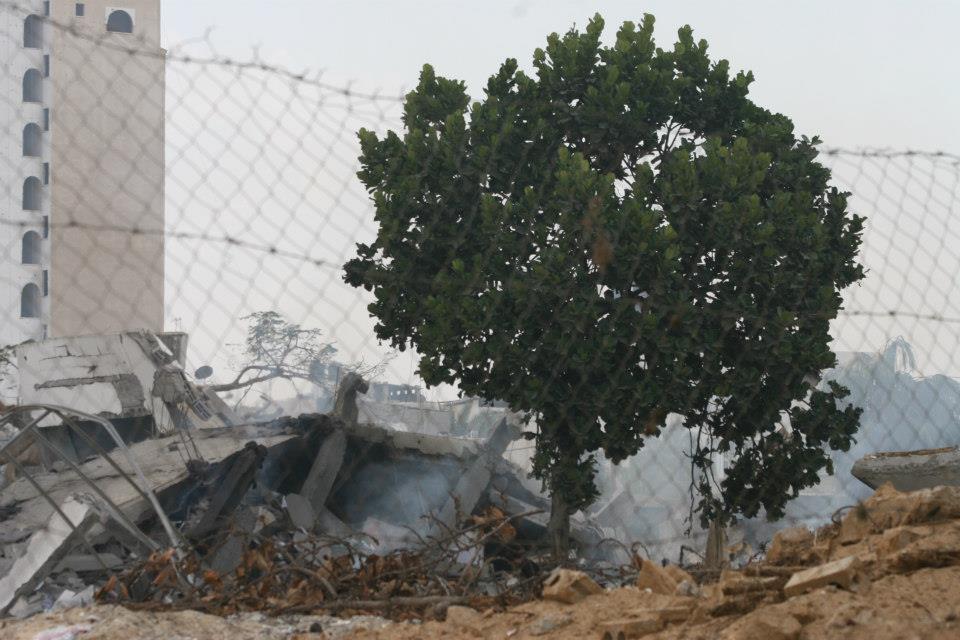
In the end, what amazed me, what somehow gave me a sense of strength
and hope,were the trees in the targeted areas. There they were -- standing up
and green... I’m not sure if it's because trees die while standing up or
because it’s their way of telling us to overcome and look for tomorrow.
Whatever their reason might be, both are lodged in my heart...
I will not upload photos any more, nor am I going to write...
because photos and words...
how hard they are and whatever dimension they have or take,
they are far from reality.

الاشتراك في:
الرسائل (Atom)